Apple Music
2025
I designed a concept feature for Apple Music that adapts to your movement and energy, helping neurodivergent users stay focused without stopping to change a song.
Overview
Music that keeps up with you
For many neurodivergent people, music isn't background noise. Rhythm and repetitive movement, like pacing or cleaning, can help with focus, regulation, and getting through everyday tasks.
FlowSync uses heart rate and movement from an iPhone and Apple Watch to notice when someone's activity changes, then gradually shifts the music to match.
Why it matters?
The goal was simple: make the music adapt to the person, not the person to the music.
Problem
Music helps create a flow state. Managing it can break it.
Take Aarav, the person I designed for. He's working from home with a calm playlist on, then decides to deep-clean the house. The music no longer fits his pace, and fixing it means skipping tracks, switching playlists, or adjusting the volume: one more task, right when he's trying to stay focused.
01 Energy shifts, 02 Music doesn't, 03 Aarav becomes the DJ
How might we take the DJ job away from the users?
I saw an opportunity where FlowSync recognizes meaningful changes in location, movement, energy and responds in the background.
Research
Understanding the relationship between movement, music, and regulation
Research Tasks: User Interviews & Literature Reviews
Insights captured:
Crucially, a growing body of academic literature links music directly to self-regulation in ADHD. Studies indicate that music (e.g., Mozart) can reduce negative mood in adults with ADHD, and experts highlight that music therapy can uniquely target the core attentional and emotional deficits associated with the condition beyond standard pharmacological treatments.
Source: Digital music interventions for stress with bio-sensing: a survey
The Gap
The problem is that mobile music apps don't know what's happening around it. It can't tell if someone is sprinting for a bus or pacing at home, so users end up babysitting their own playlists, skipping tracks and adjusting volume right when they're trying to stay focused.
That gap gets even harder to close once you factor in how similar some behaviors look from the outside:
Anxious pacing and a leisurely walk can register almost the same to a phone, but they call for very different music.
Apple Fitness already adjusts intensity prompts during a workout based on the accelerometer and the gyroscope, leveraging the changed location and the user's heart rate, but nothing adapts during the ordinary moments, like cleaning, pacing, or just getting started, where this kind of support matters most.
Constraints highlighted through research:
Building Trust
Heart rate data needs explicit consent through Apple's health permissions, so trust had to be built in from the first screen, not bolted on later. Additionally, since the whole concept leans on sensitive movement and physiological patterns, I ruled out storing or aggregating that data anywhere beyond the immediate task.
Device Power Usage
Continuous sensing drains battery fast, and sensor accuracy drops when someone moves between indoors and outdoors, so the system couldn't just poll everything constantly.
Seamless Music Transitions
Because neurodivergent users are especially sensitive to abrupt sound changes, any transition had to be smooth by design, not just accurate.
One insight sat above all the others:
An adaptive system should reduce cognitive effort, not add to it. FlowSync had to be intentional about when it steps in, subtle in how it communicates, and predictable enough to trust.
Ideation
What if your body could influence the soundtrack?
Instead of starting with screens, I started with changes in the user's state. FlowSync reads location, movement, and heart rate together and only acts when all three shift, so it can tell restless sitting from real activity.
Rather than presenting another decision, it gradually moves the music to match.

Aarav starts cleaning, his devices notice, the music follows.
Strategising interaction flows across devices
I studied how iPhone and Apple Watch could work together, using the phone as the primary listening interface and the watch for subtle, glanceable feedback.
Design Solution
Designing the transition, not just the destination
Primary Sensing and Data Integrity
The system’s core adaptive logic relies on two always-on signals combined across the iPhone and Apple Watch:
Physiological State
Continuous or periodic Heart Rate (PPG) data provides the primary measure of energy and emotional arousal.
Embodied Input
Pace and Rhythm are captured via the Watch and iPhone’s accelerometer and gyroscope, providing the kinetic input for tempo matching.
This foundation ensures that the system’s primary decision (tempo change) is only triggered when there is combined evidence, a change in gait rhythm, and a Heart Rate delta above a defined threshold.
Mapping the flow
Before touching visuals, I mapped how FlowSync would sit inside Apple Music: the states, what triggers each one, and how the phone and watch hand off to each other. Since this was a feature living inside an existing app rather than a new one, the flow had to fit Apple Music's structure, not invent its own.
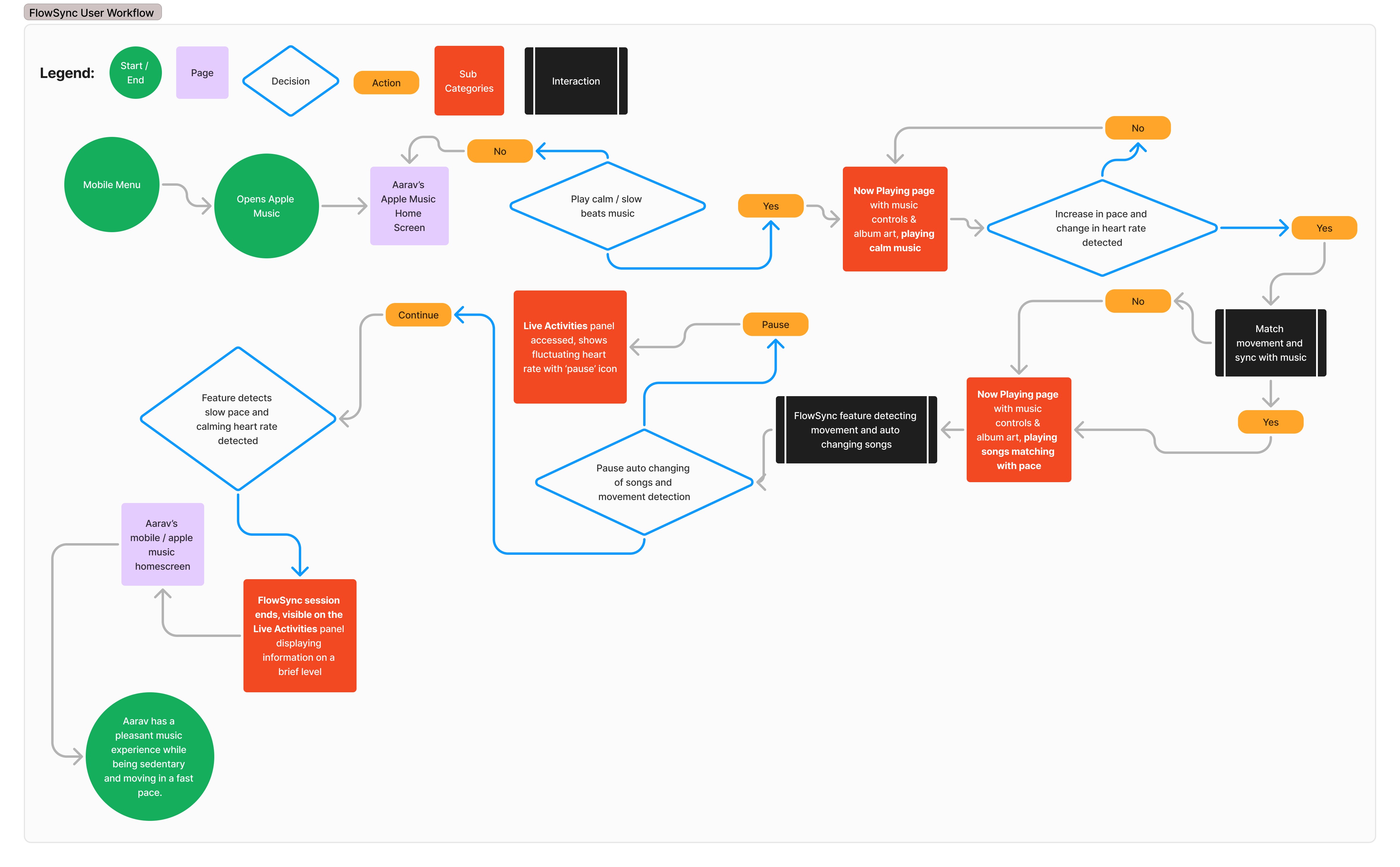
FlowSync Userflow Diagram
For the early screens, I combined real iOS components with rough wireframes, 'Frankenstein-ing rather than building everything from scratch, which let me spend my time on the adaptive logic instead of standard UI patterns.

Wireframes
Final Designs that address the success factors of the feature
Flow 1 - Synced Status & Real-Time Feedback
Flow 2 - User autonomy to pause or initiate the feature as they please
Testing & Iterations
Testing it with real people
To see if the transitions actually felt calm rather than intrusive, I ran a small in-person test with three people, incorporating a 'think-aloud protocol':
One neurodivergent participant
Two who rely on music to stay motivated during manual tasks.
Each person started seated with a calm playlist, then stood up and did a repetitive task, like light cleaning, for five minutes, while I triggered the tempo shift by hand to simulate the sensors.
Three things stood out:
01
The shift was too abrupt.
At a 2-second crossfade, one participant said it felt like an aggressive pull, and that they noticed the technology working instead of just listening to music.
02
The haptic didn't explain itself
The buzz that signaled activation wasn't clearly tied to why it happened.
03
People wanted confirmation.
More than once, someone instinctively checked the Watch mid-transition, looking for a status check.
I could upload user test images of only one consenting participant

Quote captured from the usability testing session
“It felt like an aggressive pull. I noticed the technology working instead of just listening to music.”
Refining based on feedback
Both fixes were about softening the handoff.
Making soft transitions subtly noticeable.
How does this amplify the experience?
Volume Damping and Build Up
After FlowSync identifies the matching pace via Sensor Fusion, the next song is pre-queued. At the moment of the track switch, the volume of the current song gently lowers. When the next tempo-matched song begins, it starts at that lowered volume, which then gradually increases back to the user’s usual listening level over a 2–3 second period.
Haptic Pulse Synchronization
A subtle, synchronized haptic pulse on the Apple Watch now accompanies the moment the music tempo locks into the user’s pace. This creates a tactile anchor, linking the physical movement directly to the audio change, reinforcing Embodied Interaction.
Together, these turned an abrupt jump into a soft landing.
Lessons
The best adaptive experiences know when to stay out of the way.
The hard part of an intelligent product isn't making it respond. It's deciding when to respond, how much to say, and when to get out of the way.
Designing for sensory sensitivity made everything softer. From the transitions to the feedback to the timing, and better for anyone listening. With more time, I'd test with real sensor data and more neurodivergent participants.